Some meals begin with a plan. Others begin with an open refrigerator, a tired mind and the quiet hope that something inside will make sense.
I opened the refrigerator and stared into it as though it had been hiding an answer from me.
The light came on. A cold draft touched my face. Containers sat on different shelves in no useful order, each holding either too little, too much, or something I did not feel like eating.
I moved one box aside.
Nothing appeared behind it.
I checked the vegetable drawer, although I already knew what was there. A few things remained. Some fresh, some less confident. There was corn. There were odds and ends from earlier meals. Enough to prevent the kitchen from being empty, but not enough to suggest one obvious dinner.
I stood there longer than necessary.
The refrigerator began to beep.
That sound felt judgmental.
I closed the door.
Then I opened it again.
The problem with deciding what to cook
The difficult part was not hunger.
I was hungry enough.
The difficult part was making another decision after a day full of them.
Work had already required attention, responses, small corrections and the constant movement from one thing to the next. By evening, even a simple question—what should I eat?—felt much larger than it was.
I did not want to cook a full meal.
I did not want to order something and spend twenty minutes comparing options.
I did not want to eat biscuits and pretend that counted as dinner.
What I wanted was for food to appear with no involvement from me.
The kitchen refused.
So I put the corn on the counter.
It was not yet a plan. It was only the first ingredient willing to cooperate.
That is sometimes how cooking begins when the mood is low. Not with inspiration, but with one small action. Take something out. Wash it. Find a bowl. See what happens next.
I looked around again.
A container from the refrigerator. Something crisp. Something soft. A little colour. A spoonful of this, a handful of that.
There was no recipe beside me. No carefully measured sequence. The bowl began to form through a series of practical questions.
Would this work?
Probably.
Would that be strange?
Only slightly.
Was I willing to try it anyway?
Yes, because I was hungry.
The freedom of using what is there
Corn is cheerful food.
Even before anything is added to it, it brings colour to the counter. The kernels roll away when they fall, collecting near the stove or under a plate. They refuse to remain where they are placed.
Soon, the kitchen had more movement in it.
A knife touched the chopping board in quick, uneven beats. A spoon scraped the inside of a container. Something cold met something warm. A few pieces fell outside the bowl and had to be picked up.
The meal was not becoming elegant.
It was becoming possible.
I started adding things according to texture rather than certainty. Something for crunch. Something to make the bowl feel fuller. Something sharp enough to wake up the rest. The ingredients did not match in the polished way restaurant menus describe food.
They simply stopped looking lonely once they were together.
That was the shift.
A small amount of one thing can look insufficient in its container. Beside three other small amounts, it begins to look intentional.
This is one of the useful deceptions of a bowl.
It gathers leftovers, fragments and uncertain ideas into one place and gives them a temporary sense of order.
Nothing has to be perfect. The pieces do not need to be equal. One bite may have more corn, another more crunch, another mostly whatever settled at the bottom.
The bowl keeps changing as you eat.
There is some relief in food that does not need to be repeated exactly.
If I made it again, it would probably be different. Another refrigerator, another day, another handful of ingredients needing to be used. That did not make this version incomplete.
It made it specific to the evening.
A meal without ideal conditions
We often wait for proper conditions before beginning.
The right ingredients.
The right energy.
The right amount of time.
A clear idea.
A clean kitchen.
That evening, I had almost none of them.
The counter already held things that should have been put away. The light above the stove was brighter than I wanted. I was tired, and the bowl looked more colourful than my mood.
Still, it came together.
Not beautifully at first. There were too many pale ingredients on one side, so I moved them around. One spoonful was clearly more than necessary. The first taste needed adjustment.
I added a little of something.
Then a little more.
This is where improvisation becomes either confidence or danger.
I stopped before it became danger.
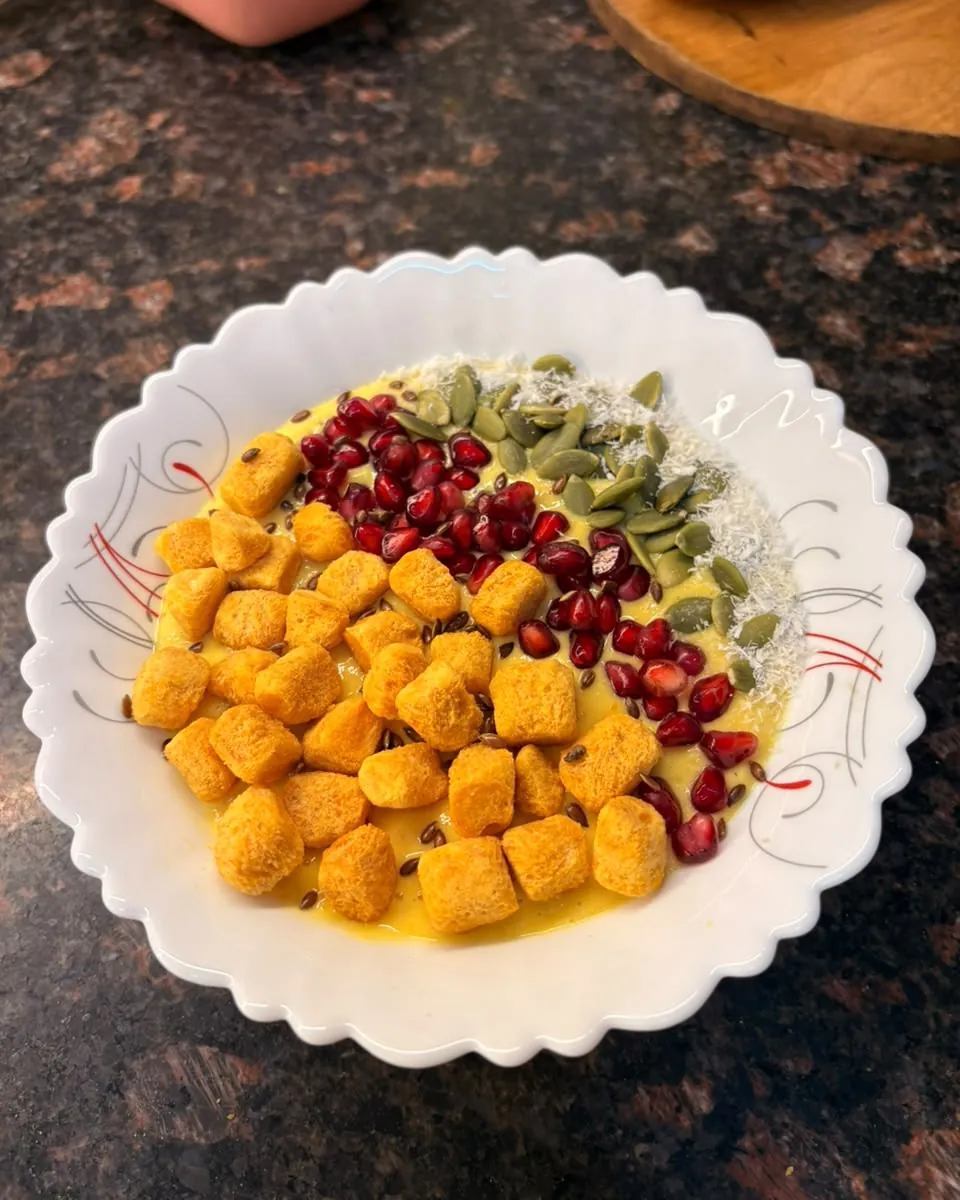
The final bowl looked lively, though not arranged. Corn showed through in bright patches. Different textures leaned against one another. Some ingredients were easy to identify; others had already disappeared into the whole.
I carried it to the table with no expectation beyond being fed.
The first bite was slightly uneven.
The second was better.
By the third, I had stopped thinking about what else I could have made.
The bowl was cool in some places and warm in others. A crisp piece broke loudly between my teeth. A softer part followed. The corn brought a gentle sweetness that made the sharper flavours feel less severe.
It was not a meal I would have planned in the morning.
That was exactly why it worked in the evening.
What the empty containers offered
After eating, I returned to the kitchen and noticed the containers on the counter.
Several were now empty.
The refrigerator had not failed to give me an answer. I had only wanted the answer to arrive already assembled.
There is a small difference between having nothing and having nothing obvious.
Tiredness makes the two feel the same.
It convinces us that available things are inadequate because they have not yet taken the shape we recognise. A little corn is not a meal. A leftover spoonful is not a meal. A few mismatched ingredients are not a meal.
Until they are.
I do not think every limitation needs to become a lesson in creativity. Sometimes an empty refrigerator is simply inconvenient. Sometimes the best decision is to order food and rest.
But there are evenings when working with what is already there feels unexpectedly kind.
No extra shopping.
No complicated preparation.
No pressure to produce something worth remembering.
Only the quiet satisfaction of having noticed what could still be used.
The bowl had not improved the day. It had not made me energetic or organised. The kitchen still needed cleaning, and work would begin again the next morning.
But I had made something from an uncertain beginning.
That mattered in a small way.
Before closing the refrigerator, I looked inside once more.
The shelves were clearer now. The remaining containers stood apart instead of crowding one another. The cold light was the same as before, but the space no longer looked unhelpful.
On the table behind me, the bowl was empty.
The answer had been there all along.
It just had not looked like dinner yet.