Some meals are remembered for the taste. Others stay because of the person across the table, the unfinished conversation and the time that briefly stopped rushing.
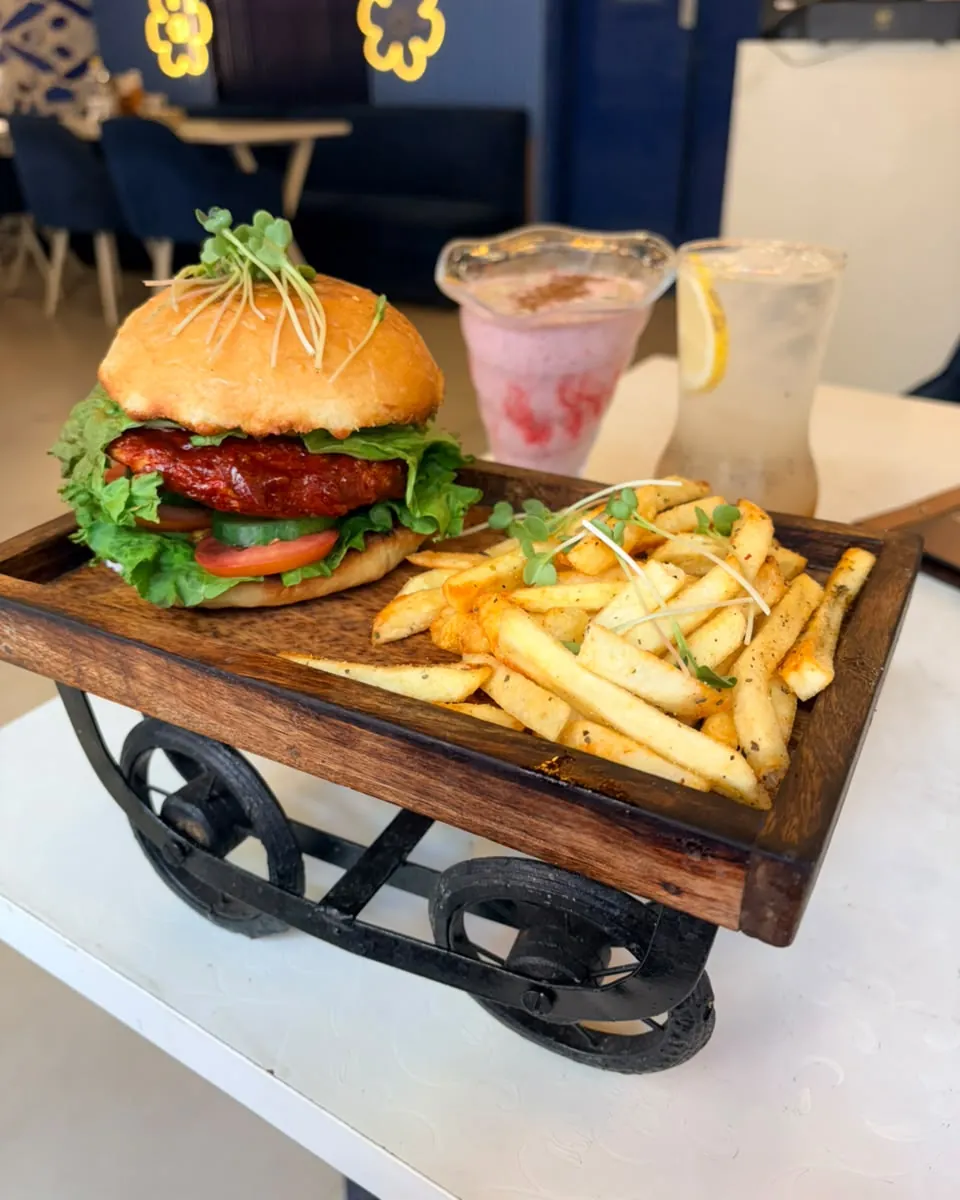
The burger arrived taller than expected.
It stood in the middle of the plate with a wooden pick pressed through its centre, holding together several layers that already looked unwilling to cooperate. The top bun leaned slightly to one side. A few pieces of filling had escaped near the bottom. Fries rested beside it, some crisp, some already softening in the warmth of the plate.
Behind the food, someone was still speaking.
I could see their hands moving around the edges of the burger—one hand near the glass, the other opening and closing as they explained something with more energy than the story probably required.
The café was noisy enough to make every conversation feel private.
Cups touched saucers. Chairs scraped the floor. A machine released steam somewhere behind the counter. Music played overhead, but nobody seemed to be listening to it. At a nearby table, someone laughed suddenly and loudly. Another person lifted a phone above their food, trying to find an angle that made the table look less crowded.
I looked at the burger again.
It seemed less like lunch and more like a practical challenge.
Before the first bite
There is always a brief moment at a café table when the food has arrived but eating has not yet begun.
The person across from you continues speaking.
You adjust the plate.
Someone reaches for a napkin.
The drink is moved out of the way, then moved back because there is nowhere else to keep it. The food is still complete, untouched and slightly formal.
That moment rarely lasts long.
My hand reached for the burger, then stopped.
It was too tall to lift comfortably and too unstable to cut without consequences. The wooden pick suggested structure, but I did not trust it. Pressing the bun down seemed necessary, though doing so would clearly push the filling out from the other side.
There was no graceful option.
The person across the table noticed.
“You will have to commit,” their expression seemed to say, even before they said anything.
I tried pressing the burger gently.
Nothing happened.
I pressed harder.
The top lowered. The middle shifted. Something slipped onto the plate.
This is the problem with oversized burgers. They are built for photographs but eaten by ordinary human jaws.
For a few seconds, both of us studied it seriously, as though the correct method might reveal itself.
It did not.
So I lifted it with both hands.
The first bite caught mostly bread.
The second was better, but less dignified.
A little sauce reached my finger. A piece of filling slid toward the plate. I leaned forward to protect my clothes and immediately understood why nobody looks elegant while eating a large burger.
Across the table, the conversation paused.
Then came the laughter.
Not cruel laughter. The comfortable kind. The kind that makes a small mess feel like part of the meal rather than a mistake.
The table between two people
Eating out creates a different kind of attention.
At home, meals often happen alongside other things. A television is on. A phone is nearby. Someone gets up to bring water, answer the door or check the stove. Familiar spaces allow us to leave a conversation and return to it later.
A café table holds people in place.
The plates create a small boundary. Drinks stand at the corners. Bags are pushed under chairs. For a while, there is nowhere else to go.
That pause can feel awkward at first.
Especially when life has trained us to keep moving.
There may be work waiting. Messages collecting. A list of things that should already have been done. Even while sitting, part of the mind continues running.
Then food begins to interrupt it.
A fry is picked up.
A straw turns in a glass.
The burger slips again.
The conversation moves from something important to something completely unnecessary, then back without warning.
This is how many good meetings happen. Not through perfect dialogue, but through interruptions.
“Wait, what were you saying?”
“Nothing, eat first.”
“No, tell me.”
“You have sauce on your hand.”
The conversation bends around the food.
Some sentences are completed. Others are abandoned because the drink arrives or someone at the next table pulls a chair too loudly. A serious thought may be followed by an argument over the last crisp fry.
The meal gives us permission to be inconsistent.
We can talk about work, worry, family, traffic, a strange video seen that morning, and whether the burger should have been served with a knife. None of it has to form one clear story.
The company is what holds it together.
What I remember from eating out
When I think about meals outside, I do not always remember flavours accurately.
I may remember that the fries were too salty or that the drink had more ice than expected. I might remember the burger being difficult to hold. But the exact taste often fades before the atmosphere does.
What remains is the person across the table.
The way they leaned forward while speaking.
The moment both of us stopped to listen to a loud sound behind us.
The unfinished sentence after a laugh.
The hand reaching across the table to take one fry without asking.
Food can be the reason people meet without being the most important part of the meeting.
“Let us eat something” is easier to say than “I want to spend time with you.”
It requires less explanation.
A meal provides structure to the pause. There is a place to sit, something to order and an obvious reason not to leave immediately. Even silence becomes easier when there is food between two people.
You can look at the plate.
You can sip the drink.
You can offer the fries.
Silence without food can feel like a question.
Silence at a table can simply mean someone is chewing.
That afternoon, the café remained busy around us. New plates arrived. Chairs emptied and filled again. The music changed. Light from outside moved slightly across the table.
We stayed longer than the burger required.
The fries had cooled. The drink was nearly finished. Only a small piece of bun and a little sauce remained on the plate.
The conversation had become slower.
There is a point during a meal when nobody is properly eating anymore, but nobody is ready to stand up either.
That is often the best part.
After the plates are cleared
Eventually, the plates were taken away.
The table looked unexpectedly bare without them.
A damp ring remained under the glass. A folded napkin sat near my hand. A few crumbs had escaped the plate and settled on the table, evidence of the earlier struggle.
Without the burger between us, there was more space.
But the pause it had created remained.
We continued talking for a little longer, no longer protected by the practical business of eating. The café was still loud, though I had stopped noticing every sound. The person across from me had reached the end of one story and begun another.
I realised that I could barely remember the last bite.
I remembered the first one because it had been difficult. I remembered the laughter. I remembered trying to keep the burger from falling apart. But somewhere between the conversation and the fries, the food had moved into the background.
That did not make the meal less worthwhile.
A dish does not have to be unforgettable for the time around it to matter.
Sometimes the food performs a quieter role. It keeps hands occupied while difficult things are said. It fills the gaps when nobody knows what to say next. It turns an hour into a place we can return to later.
We may describe it by saying, “That time we had burgers.”
What we usually mean is everything that happened around them.
When we finally stood up, the café continued without us.
Another group would take the table. Another tall burger would arrive. Someone else would press it down, lift it with both hands and discover too late that dignity was no longer an option.
I looked once at the empty place where the plate had been.
The burger had been bigger than expected.
The afternoon had become bigger than the burger.