Some afternoons do not need solving. They only need a little time, a warm kitchen, and something fragrant waiting beside the tea.
The knife met the crust with a soft crack.
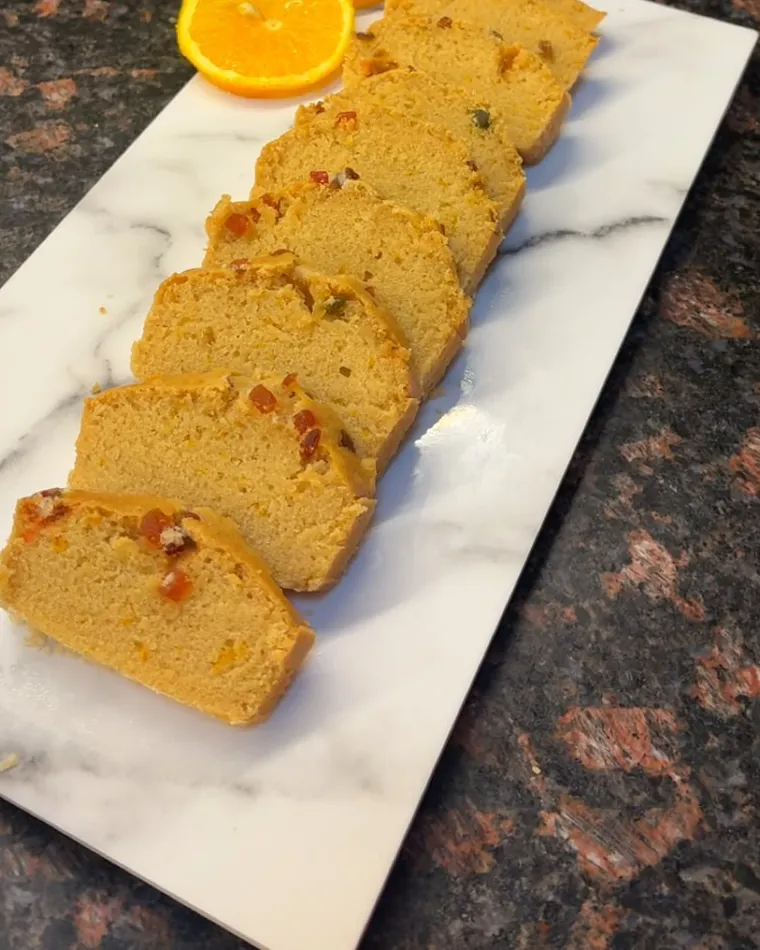
A few crumbs scattered across the marble board, brighter than they had any right to be on such an ordinary afternoon. The loaf was still slightly warm, and the first slice leaned to one side as I lifted it. It was not neat. The top had risen unevenly, one corner darker than the rest, and the crumb looked a little tighter near the bottom.
I liked it immediately.
The kitchen had been quiet before that. Not peaceful—just quiet in the way a room becomes when the day has already taken too much from you. A long stretch of work, one task following another, messages answered, things remembered, things nearly forgotten. Nothing dramatic had happened. I was simply tired of continuing.
Some days are difficult because something goes wrong. Others are difficult because nothing stops.
I had come into the kitchen with that kind of tiredness.
The orange slices were still on the counter. A few drops of juice had dried near the chopping board, leaving behind a faint stickiness. The plants near the window looked slightly dusty in the late light. Somewhere outside, a pressure cooker released steam in another kitchen. A scooter passed. A steel utensil fell with the familiar confidence of Indian households, where every sound travels further than expected.
Inside, the cake waited.
When the room begins to change
I often cook when my mood is off.
Not because cooking always makes me happy. Sometimes it makes more washing-up. Sometimes the batter looks wrong, the pan feels too small, or I realise halfway through that I have left something on the other side of the kitchen. There is no instant transformation. I do not enter upset and emerge glowing, holding a perfect cake under golden light.
It is usually slower than that.
First, there is something to do with my hands.
A bowl to hold. A spoon to scrape clean. An orange to press against the counter before cutting. A small task that asks for enough attention to interrupt the noise in my head, but not so much that it becomes another burden.
Then the aroma begins.
Orange cake does not announce itself all at once. It comes gradually. At first, there is only warmth from the oven. Then butter, sugar and citrus begin to move through the room, settling into curtains, clothes and corners. The air changes before the mood does.
That is what I notice most about baking: the room often softens first.
A kitchen that felt functional a few minutes earlier begins to feel lived in again. The counter is still messy. The sink has not emptied itself. The work waiting outside the kitchen has not disappeared. But the smell of orange makes the space feel less stern.
It reminds me that a room can hold more than one feeling at the same time.
Tiredness can remain. So can warmth.
The imperfect slice
The second slice was better than the first, though not by much.
I placed both on the board anyway.
One was thick at the top and thin at the bottom. The other had a small break near the edge, where the crumb gave way under the knife. A few orange pieces sat beside them, bright and almost too fresh-looking next to the homemade loaf.
There are foods that seem to demand perfection. Cakes often become one of them. Smooth tops, exact layers, clean slices, carefully placed garnish. We see so many finished versions that it becomes easy to forget what a cake looks like in a real kitchen.
A real cake leaves crumbs.
It may rise more on one side. The first slice may collapse slightly because patience ran out before the loaf cooled. The board may carry knife marks from many meals before this one. The tea may be poured before anyone remembers to take a picture.
None of this makes the cake less generous.
I think the imperfect crumb mattered to me because the day had felt like one long attempt to keep everything in order. Work asks for accuracy. Deadlines ask for discipline. Even small mistakes can follow you into the evening.
The cake asked for none of that.
It could simply be cut and eaten.
There was relief in not needing to correct it.
I ran a finger over the crumbs left on the board and tasted one. The citrus was softer now, less sharp than the fresh fruit. Warm, slightly sweet, with the faint bitterness that orange carries near its peel. It was not a dramatic flavour. It stayed close.
The kind of flavour that belongs beside tea.
Waiting for the kettle
The kettle began to hum.
That sound has a way of making an afternoon feel complete. Not exciting. Complete.
I set out a cup and moved the cake slightly away from the edge of the counter. The loaf had cooled enough to hold its shape, though the centre still gave off a little warmth when touched. Light from the window fell across the marble board, catching the crumbs and the thin shine of moisture on the orange slices.
For a few minutes, there was nothing to hurry.
Waiting for tea is a small pause, but it is a real one. You cannot force the water to boil faster by staring at it. You cannot answer a message with one hand and pretend the other is resting. The kettle keeps its own time.
I stood there and let it.
This is what small homemade things sometimes do for us. They do not solve the day. They do not erase tiredness or reduce the work waiting for tomorrow. They create a space beside it.
A slice of cake on a plate.
Tea gathering colour in a cup.
A warm smell that makes someone passing through the room stop for a second.
“Is that orange?”
That question is almost enough to begin sharing.
No special occasion is required. No table has to be prepared. The cake can be eaten standing near the counter, or carried to another room, or cut into pieces that are not equal. Someone may choose the darker corner. Someone else may leave the crust behind. There may be a discussion about whether it needs more orange, less sugar, or another five minutes in the oven.
Homemade food often comes with opinions.
That is part of its charm.
What remained after the last bite
By the time I sat down, the tea was hot enough to make me wait before drinking it.
The cake had cooled further. Its aroma was no longer filling the whole kitchen, but it stayed near the plate. Each bite was soft in the centre, a little firmer at the edge. The uneven slice broke easily under the fork.
The day had not become easier in retrospect. It had still been long. I was still tired. There were still things to finish.
But my mood no longer felt like the only thing in the room.
There was also the warmth of the cup between my hands. The smell of orange on my fingers. The quiet satisfaction of having made something that did not need to be impressive to be welcome.
Cooking does not always cheer me up. Sometimes it only gives the tiredness somewhere to sit.
That afternoon, it sat beside a plate of orange cake and waited while the tea cooled.
Later, the marble board still held a few crumbs from the first uneven slice.
The kitchen felt warmer than before.
Not because the day had changed, but because, for a little while, I had.